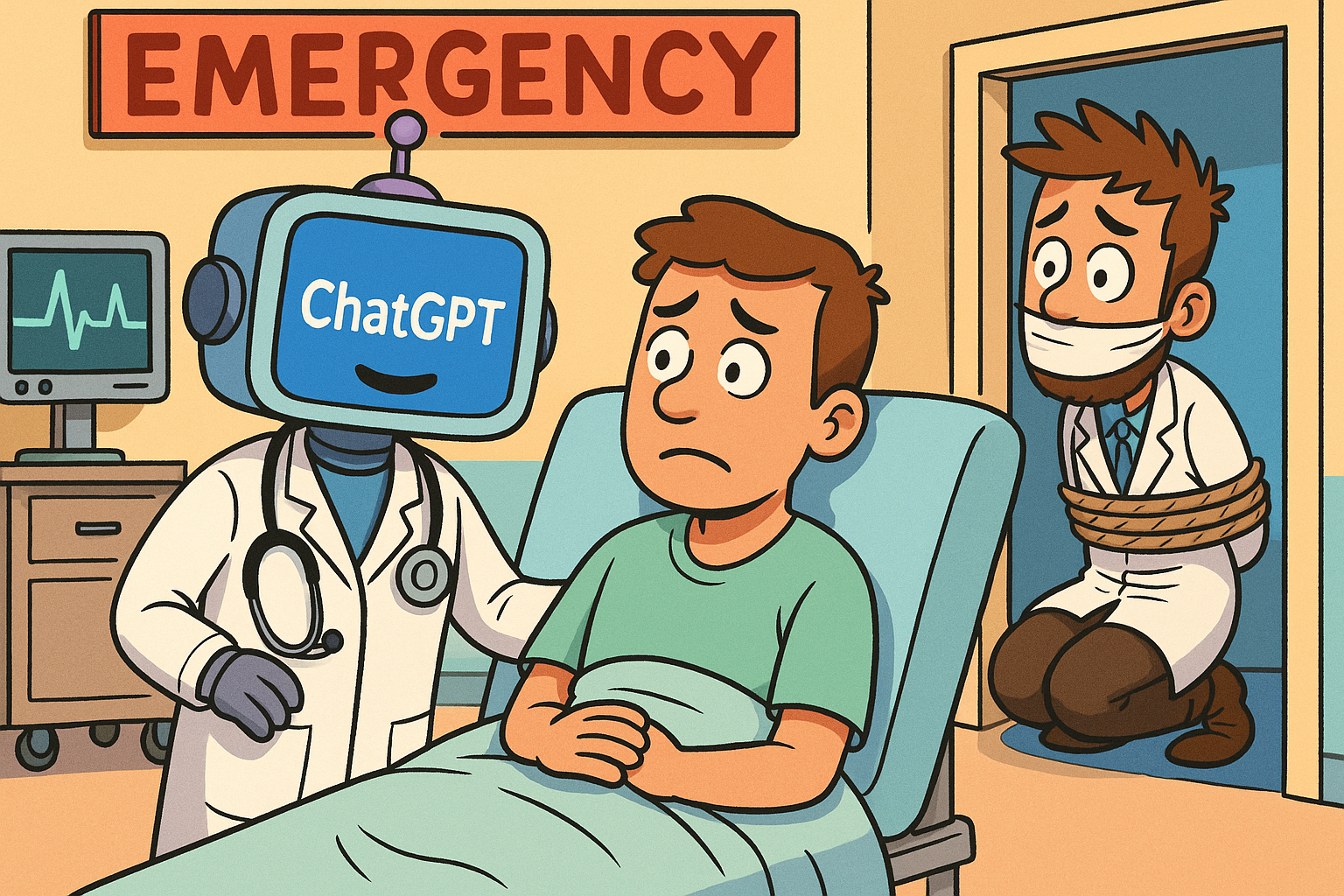
Let's be real — we've all done it. That weird rash pops up, and before you can say "WebMD," you're three clicks deep into the internet, convinced you have a rare parasitic infection. Welcome to modern healthcare, where everyone has a medical degree from the University of Google. 🎓
But here's the thing: not all online health information is created equal. And with AI chatbots like ChatGPT, Gemini, Grok, and Claude becoming popular sources for medical advice, we need to talk about what's actually safe — and what might land you in the ED.
The Rise of Dr. ChatGPT 🤖
AI chatbots have become surprisingly popular for health questions. A recent survey found that one in six adults uses AI chatbots for medical information at least once a month. That's a lot of people asking their phones about their symptoms!
And honestly? I get the appeal. AI chatbots are available 24/7, they don't judge you for asking about that embarrassing rash, and they're free. No waiting room, no copay, no awkward small talk about the hot AZ weather.
But here's where things get scary.
Where AI Learned "Medicine" (Hint: It's Not Med School) 📚
AI chatbots learn by reading enormous amounts of content and answering questions based on what they've "read." Sounds great, right? Here's the problem — AI doesn't just learn from medical textbooks and peer-reviewed journals. Look at where ChatGPT actually gets its information:
ChatGPT's Information Sources
Notice what's missing? Peer-reviewed medical journals. Evidence-based guidelines. Actual medical textbooks. Source: Concurate.com
Would you trust medical advice based mostly on blogs and review sites? I hope not! But that's essentially what you might be getting when you ask AI for health advice.
When AI Goes Dangerously Wrong ⚠️
Still think AI medical advice is harmless? Let me share a terrifying real-life example.
A 60-year-old man wanted to reduce the amount of salt in his diet — a perfectly reasonable health goal. So he asked ChatGPT for advice. The AI recommended he take sodium bromate. Here's the problem: sodium bromate is toxic to humans. The man ended up in the emergency department with bromate toxicity, suffering from paranoid delusions and other serious symptoms. All because he trusted AI advice without checking with a real doctor.
This isn't just a "whoops" moment. This was life-threatening.
Why AI Makes a Terrible Doctor 🩺
AI chatbots have some serious limitations when it comes to healthcare:
They're inconsistent. Ask the same question twice, get different answers. Your real doctor wouldn't tell you one thing on Monday and something completely different on Tuesday.
They can't see you. AI can't look at your rash, check your breathing, or notice the worried look that tells an experienced doctor something's wrong.
They hallucinate. No, not like that. AI can make up false information or cite studies that don't exist. Imagine receiving advice based on research that never took place. 😬
They don't know YOU. AI can't account for your personal health history, medications, allergies, or living situation. Good healthcare is personal.
They make mistakes with real consequences. Such as recommending toxic substances for salt reduction. Need I say more?
Where You Should Actually Get Health Info ✅
The internet has great health resources — you just need to know where to look.
🏥 Your Trusted Health Sources
These sites are written and reviewed by real medical professionals — not Reddit users with strong opinions.
Can You Ever Use AI for Health Stuff? 🤔
Yes — but think of AI as a helpful starting point, not a final answer. It can explain medical words, help you organize questions for your doctor, or translate confusing discharge instructions into plain English. That can be useful.
What it should not do is diagnose you, tell you whether to skip the ED, tell you to stop a prescribed medication, or replace the advice of someone who can actually examine you.
Reasonable Uses
Please Do Not
My Emergency Physician Rule of Thumb
If the answer could change whether you call 911, go to the ED, take a medication, stop a medication, or ignore a new symptom, do not leave that decision to a chatbot.
Use AI to get better prepared for a real conversation. Do not use it as the conversation.
AI can be a great tool for curiosity. It is not a substitute for judgment, context, or a human being who can look you in the eye and say, "Something about this does not feel right."
— Dr. Eric Cummins, MD