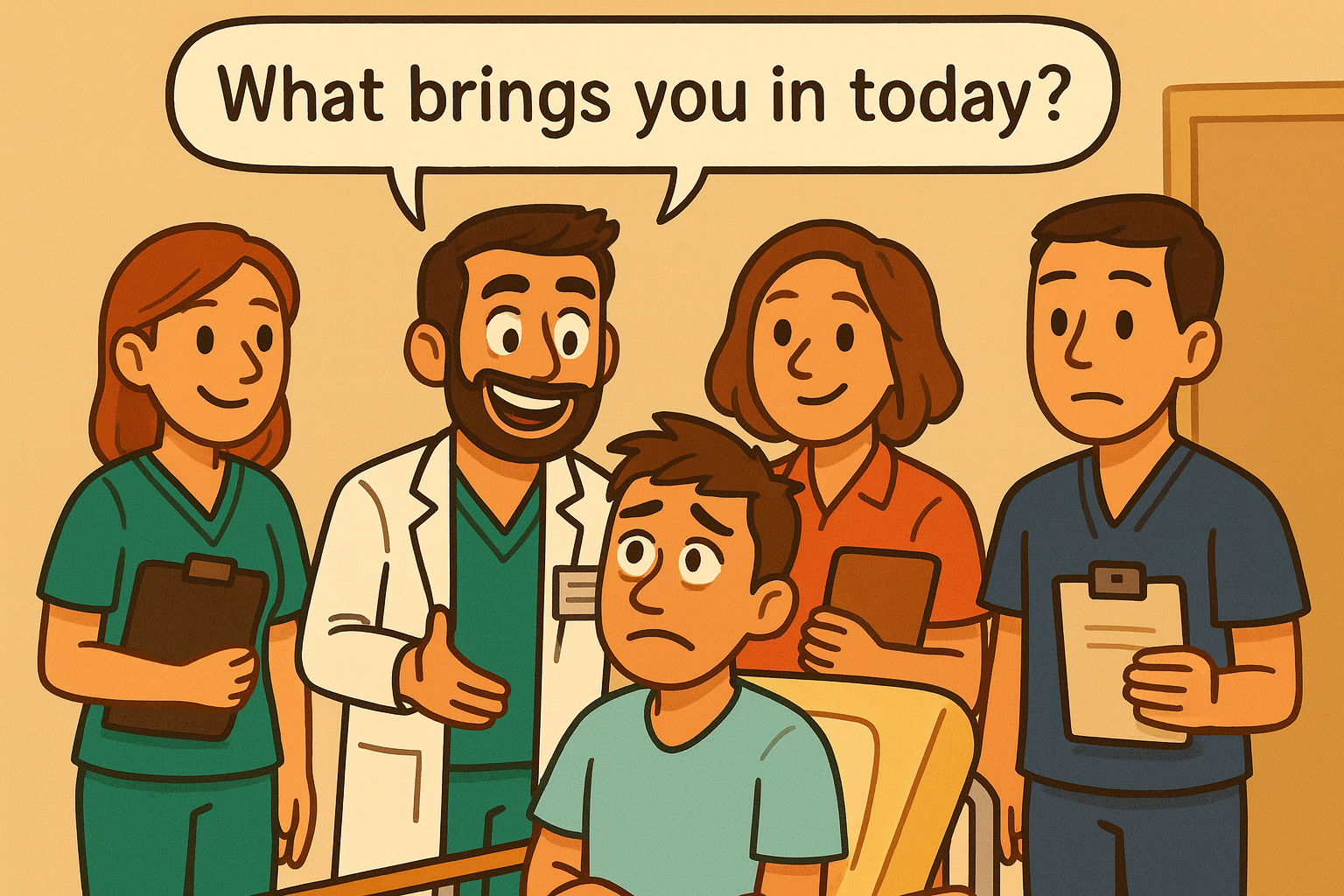
Picture this: you arrive at the emergency department with chest pain, belly pain, a cough, or a twisted ankle. You explain what happened at the front desk. Then the triage nurse asks. Then the tech asks. Then I walk in and ask the same thing again.
I can practically see the thought bubble over your head: "Did nobody write this down?"
Trust me, I get it. If I had a dollar for every eye roll I have received after asking, "So what brings you in today?" I could probably afford the fancy coffee machine in the physician lounge. Spoiler: it is still broken.
But there is a method to the madness.
The Great Communication Chain
Each person you meet has a different job. We are all listening for different things, and we need different levels of detail.
RegistrationRegistration needs the short version: chest pain, cough, ankle injury, medication problem. They are getting you into the system quickly and making sure you are in the right place.
Triage nurseThe triage nurse needs a focused version. They are checking vital signs, looking for danger signs, and deciding how urgently you need to be seen.
Nurses and techsThey may ask again because symptoms change, details get clarified, and they are preparing the room, tests, medications, and monitoring you may need.
Physician, PA, or NPThis is where the full story matters: when it started, what changed, what makes it better or worse, what you tried, your medical history, and what worries you most.
Why Can't We All Just Talk to Each Other?
We do talk to each other. We also read notes, review vital signs, look at prior records, and check what has already been documented.
But emergency medicine moves fast. Details can get lost in translation. Symptoms can change. A patient may remember something important the third time they tell the story. And sometimes the way you tell it directly to the clinician gives us clues that do not fit neatly into a checkbox.
Repetition is not meant to frustrate you. It is one of the safety nets we use to make sure important details do not fall through the cracks.
Your Story Gets Sharper
There is one unexpected benefit: by the time you get to the clinician, your story is often clearer.
You may start with, "It hurts somewhere over here," and by the third version realize, "Actually, it started after dinner, it is worse when I breathe, and it moved to my shoulder." That is useful.
Or maybe you initially said the pain was mild, but now it is much worse. That tells us something too.
Sometimes repetition catches a detail that matters. If you forgot to mention a medication allergy, a recent surgery, a fever, pregnancy, blood thinner use, or a prior heart problem, the extra question may be the moment it gets caught.
What Helps Us Help You
If you want to make the process smoother, these small things help:
Start with the headline"Chest pain since 8 AM," "right-sided belly pain for two days," or "fell and hurt my wrist" helps us orient quickly.
Tell us what changedWorse, better, new symptom, new medicine, new injury, recent surgery, or something that feels different from usual.
Bring a medication listYour medications, doses, allergies, and major medical history save time and reduce errors.
Say what worries you mostIf you are scared it is a heart attack, stroke, appendicitis, sepsis, or something else, tell us. That concern matters.
The Bottom Line
The next time you find yourself telling your story for what feels like the hundredth time, know this: each person asking has a purpose.
We are not trying to drive you crazy. That is just a bonus feature.
We are trying to make sure you get the right care at the right time, with the right information in front of the right person.
We promise we are taking notes. We may just need to hear it one more time, directly from you, to make sure we got it right.
— Dr. Eric Cummins, MD