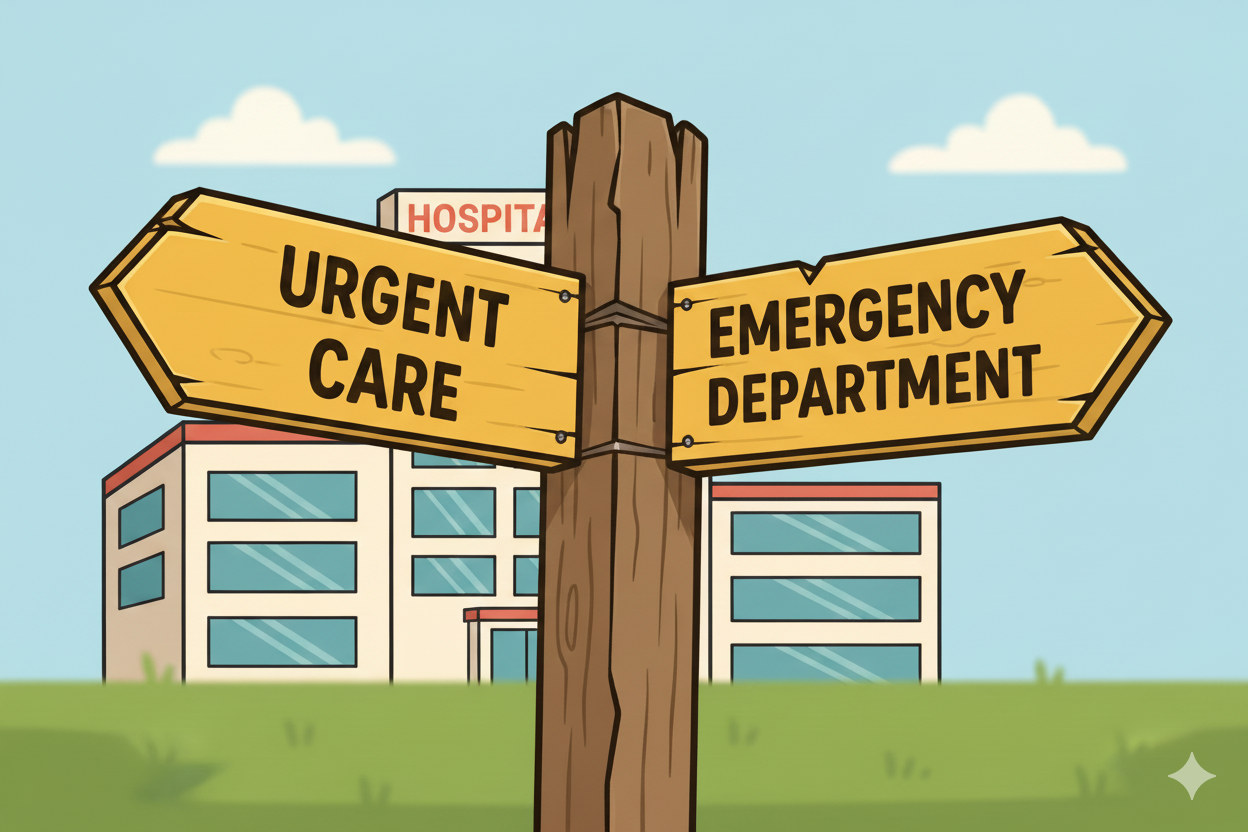
Figuring out where to go when you're sick or hurt can be confusing. Do you need the emergency department? Urgent care? Your doctor's office? Should you just ChatGPT your symptoms and hope for the best? Please don't do that last one. ChatGPT may convince you that your headache is actually a rare mosquito-borne disease.
As an emergency medicine doctor, I get it. Healthcare can feel like a maze, and when you're not feeling well, the last thing you want to do is play "Choose Your Own Medical Adventure." So let me break it down in a way that actually makes sense.
When to Head Straight to the Emergency Department
Think of the emergency department as your destination for anything that could be life-threatening or limb-threatening. If you're experiencing any of these symptoms, don't mess around. Call 911 or get to the emergency department right away.
Chest pain or pressure. This is not the time to be brave or hope it goes away. Even if you think it is just heartburn from that extra-spicy burrito, let us check it out. We'd much rather see you for heartburn than miss a heart attack.
Shortness of breath. If you're struggling to breathe or feel like you can't catch your breath, that's an ED situation. Your lungs are kind of important.
Stroke symptoms. If you notice weakness on one side of your body or face, difficulty speaking, or your face looks droopy on one side, time matters. Remember: Face drooping, Arm weakness, Speech difficulty = Time to call 911.
Severe injuries. Major cuts, deep wounds, injuries from car accidents, or anything where you're thinking, "Wow, that's a lot of blood" belongs in the ED.
Broken bones. If you think you broke something, especially an ankle, wrist, or other bone, head to the ED. Many urgent cares do not have X-ray machines or CT scanners, so they may send you to us anyway.
Severe abdominal pain. Mild stomach upset? Probably not an emergency. But if your belly hurts so badly you can't stand up straight, or if it is tender when you press on it, come see us.
When Urgent Care Is Your Best Bet
Urgent care centers are fantastic for those "I need help today, but I'm not dying" situations. They're usually cheaper than the ED, faster, and well equipped to handle common illnesses and minor injuries.
Minor cuts and scrapes. If your cut is small, not gushing blood, and does not involve a major injury, urgent care can usually clean it up and maybe place a few stitches.
Mild fevers, coughs, and congestion. Urgent care can test for strep throat, COVID-19, influenza, and sometimes RSV with quick point-of-care tests.
Minor sprains and strains. Twisted your ankle playing weekend warrior basketball? If you can still walk on it, even if it hurts, urgent care is often a reasonable first stop.
Rashes, minor burns, or bug bites. Unless you're having an allergic reaction that makes it hard to breathe, urgent care can handle most skin issues.
Joint pain without injury. Knee acting up again? Shoulder feeling stiff? If you did not injure it in a specific incident, urgent care can evaluate you and point you in the right direction.
The Gray Areas
Some situations are not black and white, and that's okay. When in doubt, here's my advice: trust your gut. If something feels really wrong, come to the ED. We'd rather evaluate you and send you home with good news than have you wait and get worse.
Head injuries are a common source of confusion. Most head injuries do not actually need a CT scan. Concussions are usually diagnosed by symptoms and exam, not fancy imaging. However, you should head to the emergency department if you hit your head and any of these apply to you:
You take blood thinners like warfarin, Eliquis, Plavix, Xarelto, or even daily aspirin; you are over 65; you lost consciousness after the injury; or you are vomiting after hitting your head.
If none of those apply and you just have a bump with a mild headache, urgent care may be able to evaluate you. Abdominal pain is probably the trickiest one. A little indigestion may be fine for urgent care or your regular doctor. Belly pain that is getting worse, in one specific spot, or making you double over is ED material.
A Few Practical Tips
Call ahead when you can. If you're going to urgent care, many places let you check in online or call ahead. It can save you time in the waiting room.
Bring your medication list. Whether you're headed to the ED or urgent care, knowing what medications you take and how much helps us take better care of you.
Don't wait until 2 AM unless it's urgent. I get it. Life gets busy. But if you've had a cough for three weeks, maybe don't wait until the middle of the night to seek care. Your future self, and the night shift staff, will thank you.
When in doubt, call. Most ERs and urgent cares have nurse lines you can call to ask whether you should come in. Use them. That's what they're there for.
What You Really Need to Know
Here's what I really want you to remember: we're here to help you, wherever you end up. The ED, urgent care, and your regular doctor's office all have their place in keeping you healthy.
The ED is for serious, potentially life-threatening situations. Urgent care is for things that need attention today but are not emergencies. And your regular doctor is for ongoing care and non-urgent issues.
At the end of the day, I'd rather see you come to the ED with something minor than stay home with something serious. We're trained to handle both, and we'll never make you feel bad for seeking care. Your health matters, and figuring out where to go is part of taking good care of yourself.
When something feels really wrong, trust that feeling. Your body usually knows when it needs help.
— Dr. Eric Cummins, MD
Now if you'll excuse me, I have to go convince someone that Google is wrong about their headache being caused by a rare mosquito bite.
← Back to ED Insights